DDR5 memory for data center is the fifth-generation Double Data Rate memory standard designed to move data quickly between processors and memory modules. Its relevance is practical: when servers process large datasets, train models, or run many virtual machines, memory bandwidth can influence how efficiently processors stay supplied with data. More bandwidth does not guarantee faster applications, though. Software, processor design, memory capacity, and workload patterns all matter.
The JEDEC DDR5 SDRAM standard, JESD79-5, specifies data rates beginning at 3,200 MT/s and extending to 6,400 MT/s in its defined range. For a real server example, Intel’s 4th Gen Xeon Scalable Processor brief lists support for DDR5 memory at up to 4,800 MT/s, subject to system configuration. These figures describe different things: the standard’s range is not a promise that every server operates at the top rate. Check the processor and platform specifications.
There is a trade-off. DDR5 can provide greater bandwidth and improved power-management features, but deployment may require compatible processors, motherboards, and DIMMs. Capacity, rank configuration, and memory population rules can also affect achievable speed. Small details matter. A data center evaluating DDR5 should compare measured performance on its own workloads, not rely on headline transfer rates alone. Benchmarks can be imperfect, and results from one server may not predict another. That uncertainty is worth stating plainly. JEDEC documentation and vendor platform guides provide a sound starting point, while workload testing helps determine whether DDR5 memory for data center delivers meaningful gains in practice.
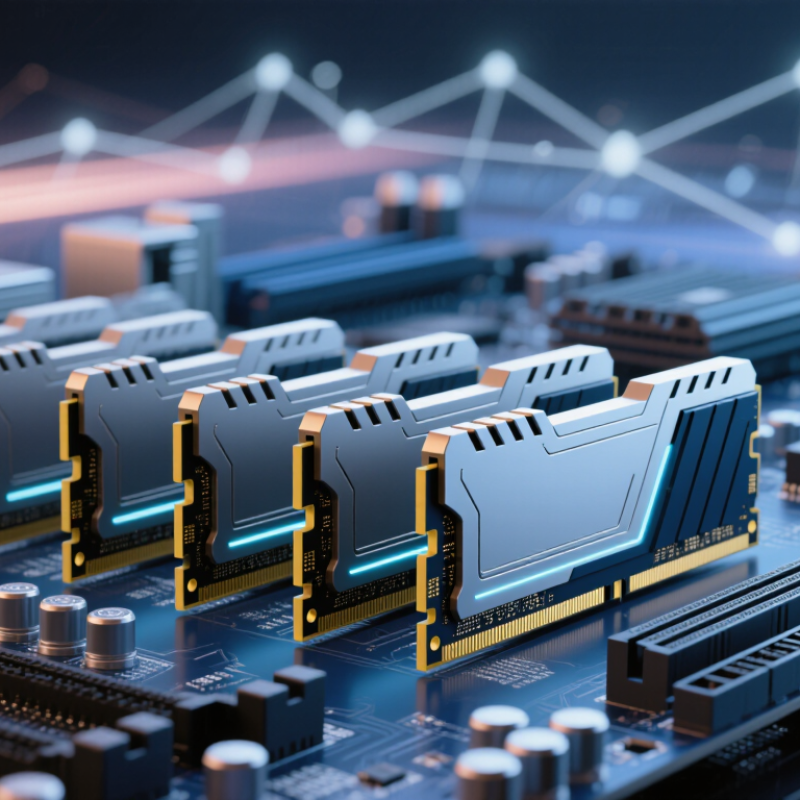
DDR5 Memory: Definition and Basic Architecture
DDR5 memory is the fifth generation of double-data-rate synchronous DRAM. It transfers data on both edges of each clock cycle, helping servers move more data without simply raising clock speed. JEDEC’s DDR5 SDRAM specification, JESD79-5, defines transfer rates up to 6,400 MT/s. At that rate, a 64-bit data path offers a theoretical peak of 51.2 GB/s. Real workloads rarely sustain that figure.
The architecture changes how a memory module handles requests. A standard DDR5 module divides its data path into two independent 32-bit subchannels. Each can process requests separately, which may improve access efficiency when a server handles many small transactions. The module also includes a power-management integrated circuit, shifting voltage regulation closer to the memory. On-die error correction can repair certain errors inside the memory chips, but it does not replace system-level ECC. Details matter.
For a data-center operator, these changes affect bandwidth, power delivery, and memory-controller design. They do not guarantee faster applications. Database lookups may benefit differently from large sequential transfers, and mixed workloads can be stubborn. The specification gives a useful ceiling, not a promise. A careful evaluation should compare memory capacity, channel population, and measured workload performance—not transfer rate alone.
How DDR5 Differs from Earlier Memory Generations
DDR5 is more than a faster version of DDR4. JEDEC’s published specifications set standard data rates up to 6,400 MT/s for DDR5, compared with 3,200 MT/s for DDR4. These figures describe transfers per second, not clock speed.
In a server handling many requests, higher bandwidth can help feed processors with data. But workloads differ; extra bandwidth may bring little benefit when storage or software is the bottleneck.
The memory layout also changes. A standard DDR5 module provides two independent 32-bit subchannels, rather than DDR4’s single 64-bit channel. This can improve access efficiency for mixed requests. DDR5 also adds on-die error correction, which addresses certain chip-level errors; it does not replace system-level error-correcting memory.
JEDEC’s JESD79-5C specification lists a 1.1-volt operating voltage for DDR5, versus 1.2 volts for DDR4. DDR5 modules also include power-management circuitry.
That sounds straightforward. Yet lower voltage alone does not guarantee lower server energy use: total power depends on workload, module capacity, and system design. I’d be cautious about treating a generation upgrade as an automatic efficiency gain.
Key DDR5 Features for Data Center Workloads
DDR5 matters in data centers because memory bandwidth can limit virtual machines, databases, and analytics jobs. JEDEC’s JESD79-5C specification defines data rates up to 6,400 MT/s. At that rate, a 64-bit data path can deliver up to 51.2 GB/s in theory. Real workloads achieve less. Still, the extra headroom can help servers process more concurrent requests without waiting as long for memory.
DDR5 DIMMs split the data path into two independent 32-bit subchannels. That lets a memory controller handle smaller, separate requests more efficiently. The DIMM also includes a power-management circuit, shifting some voltage regulation from the motherboard. On-die error correction is another feature. It can correct certain errors inside the memory chip, but it does not replace system-level ECC. Important distinction. For operators, these changes may support higher throughput and denser server configurations, but performance depends on the CPU, memory population, and workload. A careful benchmark still matters; specifications alone can make gains look larger than they are.
What Is DDR5 Memory for Data Centers? - Key DDR5 Features for Data Center Workloads
| Feature |
DDR5 Detail |
Relevance to Data Center Workloads |
| Data rate |
Common standard DDR5 data rates include 4,800–6,400 MT/s, depending on the memory module and platform. |
Higher data rates can increase peak memory bandwidth for workloads such as analytics, scientific computing, and virtualized services. Actual speed depends on CPU support, DIMM population, and system configuration. |
| Peak bandwidth |
A 64-bit data path provides a theoretical peak of 38.4 GB/s at 4,800 MT/s and 51.2 GB/s at 6,400 MT/s, before protocol overhead. |
Useful for estimating bandwidth per memory channel. A server’s total bandwidth depends on the number of active CPU memory channels and the supported operating rate. |
| Two subchannels per DIMM |
A standard DDR5 DIMM divides its 64-bit data interface into two independent 32-bit subchannels, excluding any additional ECC bits. |
Independent subchannels can improve access flexibility and concurrency for mixed or smaller memory requests. They do not double the DIMM’s total data width. |
| On-die ECC |
DDR5 chips include on-die error-correcting code to detect and correct certain errors within the memory device. |
It supports reliability inside the DRAM chip, but it does not replace system-level ECC, which protects data across the memory interface and is a separate platform capability. |
| Module-level power management |
DDR5 DIMMs place power-management circuitry on the module. The nominal DRAM supply voltage is 1.1 V. |
Moving power regulation onto the DIMM helps manage power delivery locally. Actual system power and thermal requirements vary with memory configuration and workload. |
| Capacity and scalability |
DDR5 supports high-capacity server DIMM configurations. The maximum usable memory depends on DIMM type, processor, motherboard, and firmware limits. |
More memory can reduce paging and support larger in-memory databases, caches, virtual machines, and AI data sets. Check the platform’s qualified capacity and DIMM population rules. |
| Latency and performance |
DDR5’s higher data rates do not guarantee lower access latency; timings and real-world latency vary by module and system configuration. |
Bandwidth-bound applications may benefit from higher throughput, while latency-sensitive applications should be benchmarked on the intended server configuration. |
| Compatibility |
DDR5 uses a different DIMM design from DDR4 and is not interchangeable with DDR4 memory slots. |
A compatible processor, motherboard, and supported DDR5 DIMM type are required. Mixing memory types or unsupported module configurations is not a valid upgrade path. |
Note: Data rates, bandwidth figures, and voltage are standard-level values. Supported speeds and usable capacity depend on the specific server platform and memory configuration.
Server Compatibility and Deployment Requirements
DDR5 is the fifth-generation memory standard used in newer data-center servers. In practice, a faster data rate alone does not guarantee a compatible upgrade. TrendForce’s 2024 server DRAM outlook projected DDR5 penetration to exceed 50% that year, signaling a broad platform transition. Check the server’s processor generation and motherboard documentation before ordering modules.
Compatibility is specific. DDR5 and DDR4 modules cannot share a memory slot, and server registered DIMMs are not interchangeable with unbuffered modules. JEDEC’s JESD79-5 standard defines DDR5 operation, including a nominal 1.1-volt supply. The server platform must also support the module’s capacity, rank layout, and error-correction features. Slot order matters. Follow the system’s population rules: filling more slots or using higher-rank modules can reduce the supported transfer rate. A server may run below a DIMM’s advertised speed; that is normal, not necessarily a fault.
During deployment, update firmware, confirm the approved module list, and test memory training before moving workloads. Check temperature and error logs after installation, especially in dense racks with restricted airflow. Small details matter. I have seen upgrade plans treat memory as a simple swap; that assumption often misses firmware limits and channel balancing. Stage a small batch first, then compare its measured speed and error counts with the server’s baseline.
What Is DDR5 Memory for Data Centers? Server Compatibility and Deployment Requirements
The chart shows theoretical bandwidth per 64-bit memory channel, calculated from the listed DDR5 data rates; real-world performance varies by workload and server configuration. Before deployment, verify that the server processor and motherboard support DDR5, and use the supported DIMM type and configuration. Data rates and compatibility differ across platforms.
Performance, Capacity, and Reliability Considerations
DDR5 raises memory bandwidth through faster transfer rates and architectural changes, which can help servers handling analytics, virtualization, and memory-heavy databases. More bandwidth helps. Yet performance depends on the whole platform. Processor memory channels, DIMM population, firmware settings, and workload access patterns all affect results. A workload limited by storage or processor speed may show little benefit. Higher memory speed can also involve trade-offs in capacity or latency, depending on the configuration.
Capacity planning needs more than a count of installed modules. Check the server’s supported DIMM types, per-channel limits, and population rules before choosing a layout. Uneven population can leave memory channels underused. It is tempting to assume that the largest configuration is automatically best; that assumption can be wrong. Leave room for workload growth, but measure actual memory use to avoid paying for capacity that sits idle.
Reliability depends on platform-level protections, not just the memory generation. DDR5 on-die error correction helps address certain errors within a chip, but it does not replace system-level ECC or the server’s broader error-detection and recovery features. Not always. Confirm support for ECC, monitoring, and recovery functions in the complete system. Also check airflow and operating temperatures: densely populated memory can add heat around the processor sockets. Small details matter. A practical evaluation should compare real workload performance, error reporting, and thermal behavior under sustained load.
Conclusion
DDR5 memory for data center is the latest generation of system memory designed to move data efficiently between processors and other server components. It uses an updated architecture that supports higher data rates and improved power management compared with earlier memory generations. Its design also enables greater memory capacity and more efficient handling of demanding, concurrent workloads, making it relevant to applications that process large volumes of data.
Deploying DDR5 requires servers and processors that explicitly support the technology, along with compatible memory modules and configurations. Data center operators should assess performance needs, capacity targets, power use, and system reliability before upgrading. Faster memory can help reduce bottlenecks, but its benefits depend on the wider server platform and workload. Careful compatibility checks, balanced memory configurations, and ongoing monitoring help ensure that DDR5 systems deliver dependable performance at scale.

 Memvora